
International student administration involves much more than processing applications and issuing admission letters. Universities must coordinate international admissions, identity documents, visa-related information, fee payments, enrolment, academic records, attendance, and student support across multiple departments.
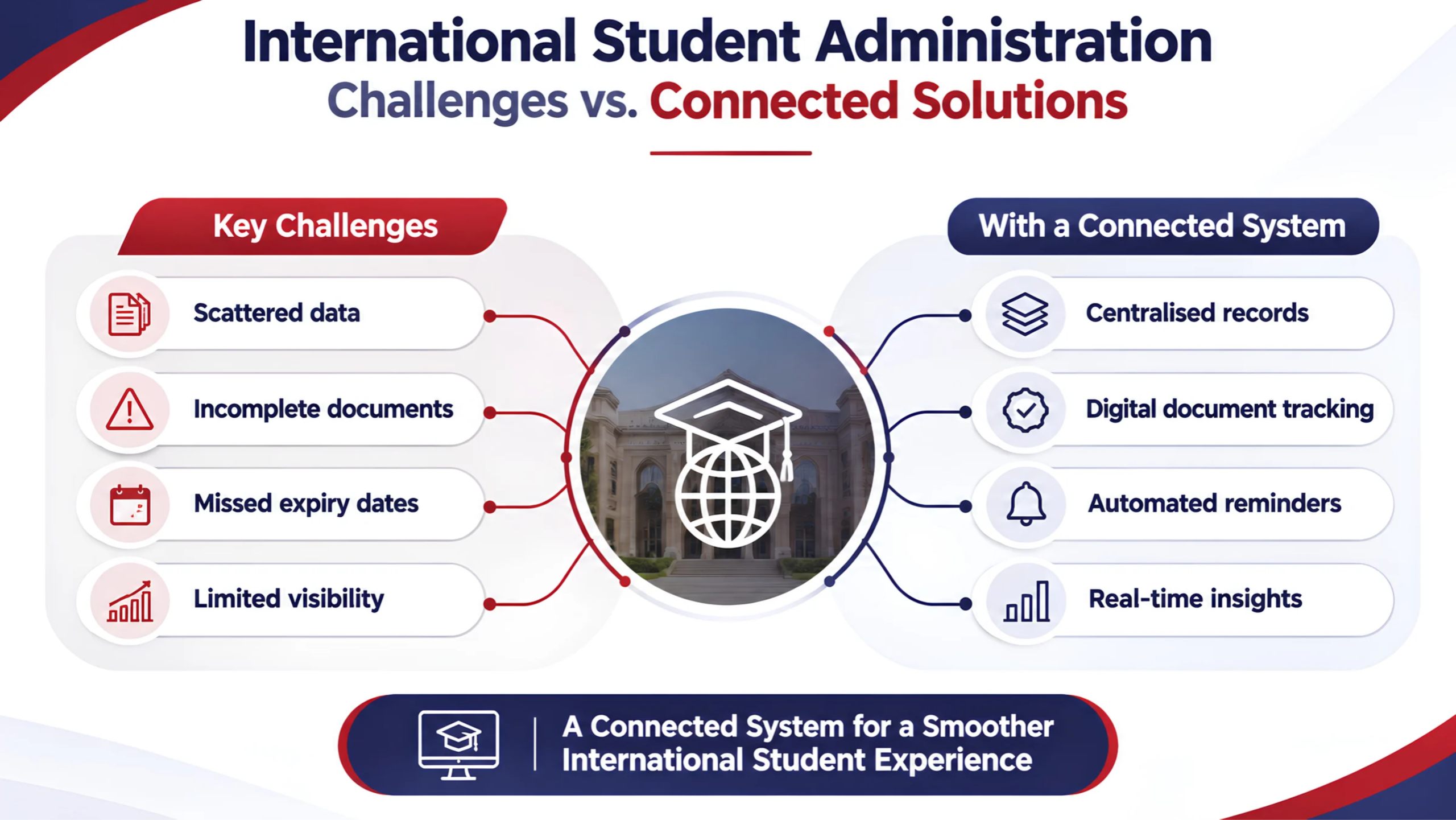
Unlike domestic admissions, international student management often involves additional documentation, country-specific regulatory requirements, different fee structures, and coordination across time zones. When these processes are managed through spreadsheets, emails, and disconnected applications, universities may experience delayed approvals, duplicate records, inconsistent information, and limited visibility into student progress.
The scale and complexity of international education make these challenges increasingly important. The OECD’s 2026 report, International Students in Higher Education, examines the student journey across six major destinations, including Australia, Canada, France, Germany, the Netherlands, and the United Kingdom. It highlights challenges ranging from obtaining study permits and finding accommodation to academic integration, progression, and post-graduation pathways.
For universities, this means international student administration must extend beyond admissions. Institutions need a connected approach that supports students throughout their academic journey while helping administrative teams manage information accurately.
University management software, particularly a Student Information System (SIS) and Higher Education ERP, can help institutions centralise these activities, automate routine workflows, and improve coordination between departments.
International admissions involve additional stages and documentation requirements beyond domestic admissions, including receiving applications, verifying international eligibility, assessing academic qualifications, validating country-specific documents, checking visa requirements, and issuing admission decisions.
Applicants may submit academic transcripts, identification documents, language proficiency certificates, passport details, and other country- or programme-specific requirements. Managing these documents manually can increase administrative workloads and make it difficult to track incomplete applications.
A university management system can streamline this process through:
For example, when an applicant submits an incomplete application, the admissions team can identify the missing documents and initiate a follow-up rather than manually searching through multiple email conversations.
International students may have additional administrative information associated with their enrolment, including passport details, visa or residence permit information, emergency contacts, sponsorship details, and country of origin.
When these details are maintained across separate spreadsheets and departmental databases, universities may struggle to maintain accurate and up-to-date records.
A centralised Student Information System creates a consistent student profile that authorised departments can access according to their responsibilities.
This can help universities:
Academia’s analysis in How Malaysian Universities Can Manage International Student Data and Administration highlights how even a simple passport update can create unnecessary administrative handoffs when departments operate through disconnected systems. A connected student record helps authorised teams work with the same updated information.
Importantly, software supports the recording and monitoring of documentation; universities must still verify immigration requirements and regulatory obligations with the relevant authorities.
Visa and immigration documentation is one of the most sensitive aspects of international student administration.
Depending on the destination country, universities may need to maintain information about study permits, residence permissions, passport validity, enrolment status, and other documentation required by local regulations.
A university management system can support these processes by providing:
For example, if a student’s residence permit is approaching its recorded expiry date, the system can help authorised staff identify the record and initiate the institution’s established follow-up process.
The objective is not to replace immigration authorities or provide legal verification. It is to help universities maintain organised documentation and improve administrative visibility.

International student fee management can be more complicated than domestic fee administration. Universities may have different tuition structures, payment schedules, scholarships, sponsorship arrangements, and currency requirements.
When financial information is maintained separately from student records, finance and admissions teams may struggle to confirm payment status and communicate accurate information.
University management software can connect fee management with student information through:
For example, when an international student completes a tuition payment through an integrated payment gateway, the relevant financial record can be updated and made available to authorised departments.
This improves visibility into outstanding payments, reduces repeated manual updates, and supports better coordination between finance and admissions teams.
Admission is only the beginning of the international student journey. After accepting an offer, students must complete enrolment, register for courses, understand academic requirements, and access university services.
When these activities are managed through disconnected systems, students may need to submit the same information repeatedly or contact multiple departments for routine updates.
An integrated university management system connects:
For international students, this provides a more consistent administrative experience. Faculty and administrators can access relevant student information without repeatedly requesting the same details from different departments.
International students may face additional challenges when adjusting to a new academic environment, understanding university procedures, or accessing support services.
Communication gaps can become more significant when students and university staff operate across different time zones.
A university management system can improve communication through:
ICEF Monitor’s September 2025 analysis, The Four Key Trends That Will Shape International Student Mobility for the Next Decade, identifies affordability, return on investment, changing destination preferences, and evolving policy environments as important influences on international student mobility.
These developments make the student experience an important consideration for universities competing internationally. Timely communication, accessible information, and responsive administrative services can help institutions provide better support throughout the student journey.
International student records contain sensitive personal and academic information. These may include passport details, identification documents, financial records, contact information, and academic histories.
Universities must ensure that this information is accessible to authorised personnel without exposing confidential records unnecessarily.
Academia’s guidance in How Can Universities Protect Student Records and Control Data Access Through an SIS? highlights the importance of role-based access, secure authentication, audit trails, encryption, and consistent data governance.
A suitable university management system should support:
For example, an international admissions officer may require access to application documents and passport information, while a faculty member may only need access to relevant academic records.
Clearly defined access permissions help universities maintain this distinction.
Managing international students across programmes, departments, and campuses generates considerable administrative data.
Without connected reporting, institutional leaders may need to collect information from admissions, finance, academics, and student services before understanding overall performance.
A university management system can bring this information together through dashboards and reports covering:
With extensive experience in higher education technology, Academia offers 800+ standard reports and dashboards and 400+ AI-powered reports, providing universities with in-depth insights across academic, administrative, financial, and student management operations.
These reporting capabilities help institutions analyse international enrolment by country and programme, monitor admission conversions, track outstanding fees, review academic performance, and identify student progression trends.
By bringing these insights together, universities can identify operational gaps, evaluate performance, and make informed decisions about international student management and institutional planning.
For example, country-wise enrolment reports can help institutions understand which international markets contribute to their student population, while progression reports can highlight areas requiring additional academic support.
Not every university management system is designed to support the additional administrative requirements associated with international education.
Before selecting a platform, universities should evaluate whether it can connect international student information with broader institutional operations.
| Evaluation area | What universities should look for |
|---|---|
| International admissions | Online applications and document submission |
| Student records | Centralised profiles and document histories |
| Visa-related administration | Configurable records and expiry reminders |
| Fee management | Flexible fee structures and payment tracking |
| Academic administration | Enrolment, attendance and examinations |
| Communication | Student portals and automated notifications |
| Data security | Access controls, encryption and audit trails |
| Reporting | Country-wise enrolment and performance insights |
| Integration | Connectivity with relevant institutional systems |
| Scalability | Support for additional campuses and international enrolments |
Universities should also request demonstrations using actual administrative scenarios, such as processing an international application, updating passport information, recording a fee payment, and reviewing a student’s enrolment status.
Academia by Serosoft offers a Higher Education ERP and Student Information System designed to connect academic and administrative operations through a unified platform.
For universities managing domestic and international student populations, its capabilities can support several important administrative requirements:
With capabilities supporting institutions across different educational environments, Academia helps universities reduce administrative fragmentation and improve coordination across the student lifecycle.
Explore Academia’s Student Information System to understand how an integrated platform can support your institution’s student management requirements.
Managing international students requires universities to coordinate admissions, documentation, financial records, academic processes, compliance-related information, and student support across multiple departments.
Disconnected systems can make these responsibilities more difficult by increasing manual work, creating inconsistent records, and limiting institutional visibility.
An integrated university management system helps bring these processes together through centralised student information, connected workflows, automated notifications, controlled data access, and reporting capabilities.
For institutions looking to expand international enrolment, improve administrative efficiency, and deliver a more connected student experience, investing in the right university management software can support long-term institutional growth.
The goal is not simply to manage international student records. It is to create a connected administrative experience from application to graduation.
International student administration involves managing the academic and administrative requirements of students studying outside their home countries. It includes admissions, documentation, visa-related records, enrolment, fees, academic progress, and student support.
University management software centralises student information and connects admissions, documentation, fee management, academics, attendance, examinations, communication, and reporting. It helps reduce manual administration and improve coordination between departments.
An appropriately configured SIS can maintain passport and visa-related information, record expiry dates, and generate reminders for authorised staff. Universities remain responsible for verifying applicable immigration requirements and taking necessary action.
Depending on institutional and country-specific requirements, these may include passport copies, visa or residence permits, academic transcripts, admission letters, language proficiency certificates, insurance details, and emergency contact information.
Universities should use centralised student records, role-based access permissions, secure authentication, encryption, audit trails, backup procedures, and clearly defined data governance policies.
Important features include international admissions management, centralised student records, document management, configurable visa-related tracking, fee management, academic administration, student portals, communication, reporting, integration, and data security.

Experience Academia – Your partner in transforming campus operations, a trusted all-in-one ERP/SIS solution.
Get the latest insights, trends, and updates delivered straight to your inbox!